
PriceLabs vs. Beyond Pricing vs. Wheelhouse: Which AI Pricing Tool Actually Fits Your Property?
I ended up testing all three of the major AI pricing tools for short-term rentals, not because I love research for its own sake, but because I run two very different Adirondack cabins through a ski-and-lake seasonal calendar, plus two flat-rate Philly long-term rentals that make the whole pricing conversation feel almost quaint by comparison. When your revenue swings from “sold out at premium rates” to “genuinely nobody wants this cabin in April” within the same six weeks, you start caring a lot about which algorithm actually understands that.
So here’s the full side-by-side: PriceLabs, Beyond Pricing, and Wheelhouse, compared on the things that actually change which one you should pick — not just feature checklists.
TL;DR
PriceLabs wins on control and integration breadth (150+ PMS connections) but has the steepest learning curve. Beyond Pricing wins on hands-off simplicity but costs more as revenue grows (1%–1.25% of revenue, no flat-fee option). Wheelhouse wins on setup speed and interface (usable free plan, running in under two hours) but lacks a direct Vrbo connection and mobile app. There’s no universal “best” — the right pick depends on how much manual control you want and whether your revenue is high enough that a percentage fee starts costing more than a flat one.
Jump to a Section
- Quick Comparison Table
- Pricing Math: Flat Fee vs. Percentage of Revenue
- Control vs. Simplicity
- Integration Coverage
- Accuracy by Market Type
- A Real Scenario: Pricing a Powder Day
- The Decision Framework
- Which One We’re Actually Running
- FAQ
Quick Comparison Table
| Feature | PriceLabs | Beyond Pricing | Wheelhouse |
|---|---|---|---|
| Starting cost | $19.99/listing/mo or 1% revenue | 1% (Growth) / 1.25% (Pro) of revenue | Free (1 listing), or $2.99/mo min. (Pro Flex) / $19.99/listing/mo (Pro Flat) |
| Free trial/plan | 30-day free trial | Contact for trial terms | Free plan, permanent, 1 listing |
| PMS integrations | 150+ (broadest) | 40+ major platforms | Fewer direct; no native Vrbo |
| Setup time | A weekend, plus weeks of tuning | An afternoon | Under 2 hours to a usable strategy |
| Manual control | Highest — granular seasonality/event rules | Lower — fewer dials by design | Medium — streamlined rule-builder |
| Mobile app | Yes | Yes | No (web-only, 2026) |
| Strongest at | Thin/niche comp markets, granular control | New/seasonal listings, multi-channel sync | Event-heavy urban markets, fast onboarding |
| Biggest complaint | Cluttered interface, learning curve | Slow support, fee scales with revenue | No native Vrbo connection |
Pricing Math: Flat Fee vs. Percentage of Revenue
This is the single biggest cost variable across all three tools, and it’s worth understanding properly instead of just picking whichever percentage sounds smallest. PriceLabs and Wheelhouse both offer a genuine flat-fee option ($19.99/listing/month, before volume discounts); Beyond Pricing does not — every tier is percentage-based.
Here’s the crossover math for a single listing, comparing a $19.99 flat fee against 1% of revenue:
| Monthly revenue | 1% of revenue | Flat fee ($19.99) | Cheaper option |
|---|---|---|---|
| $500 | $5 | $19.99 | Percentage |
| $2,000 | $20 | $19.99 | ~Breakeven |
| $5,000 | $50 | $19.99 | Flat fee |
| $10,000 | $100 | $19.99 | Flat fee |
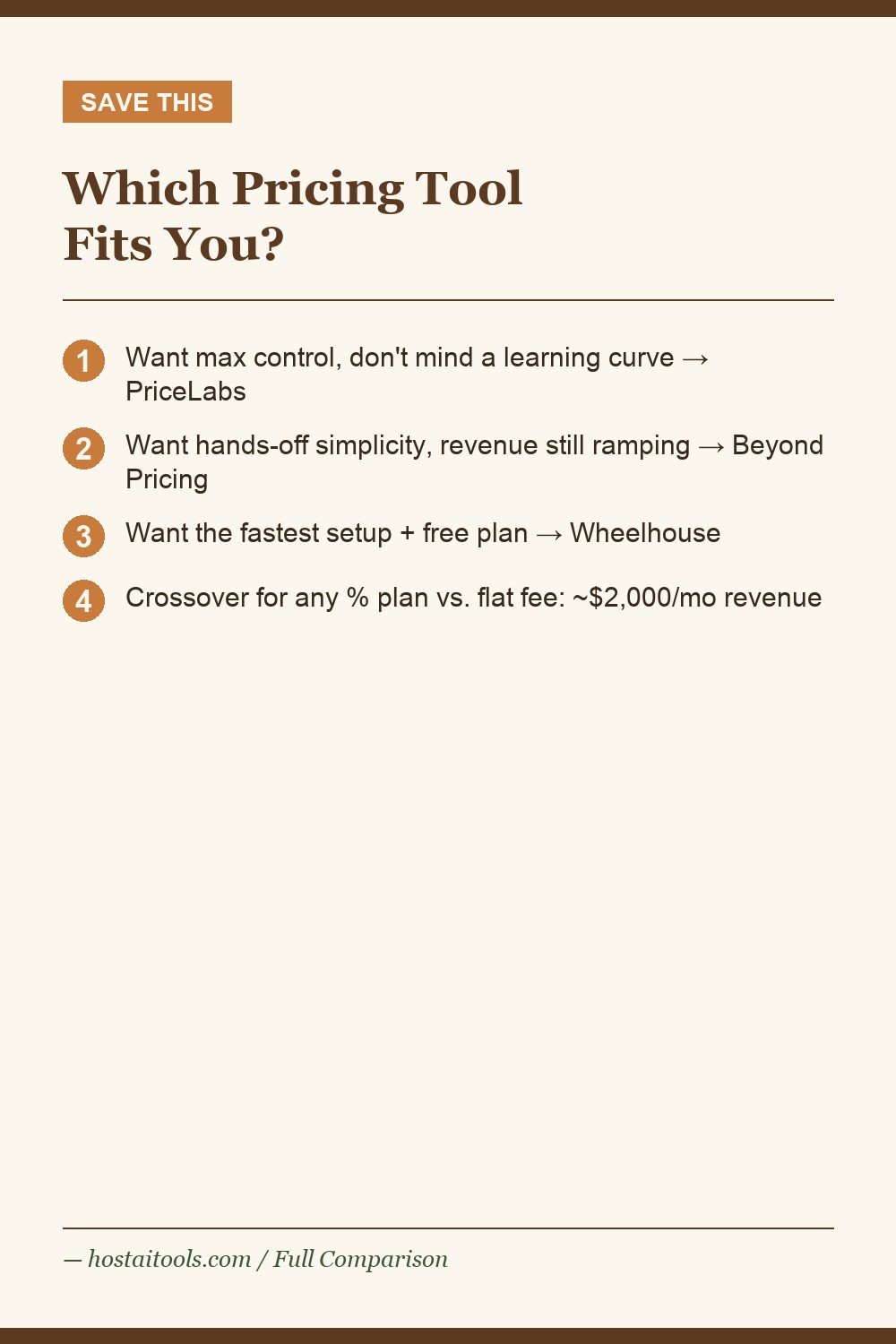
The crossover point sits right around $2,000/month in revenue. Below that — a new listing, an off-season month, a genuinely low-ADR market — percentage-based pricing (Beyond, or Wheelhouse’s Pro Flex) is cheaper. Above it, the flat-fee tools (PriceLabs or Wheelhouse’s Pro Flat) win on pure cost. Add in Beyond’s higher 1.25% Pro tier and the crossover for that plan drops to around $1,600/month.
Don’t stop at this table, though — the cheaper option on paper isn’t automatically the better one if the more expensive tool drives meaningfully more bookings. Treat this as your cost baseline, not your final decision.
Control vs. Simplicity
This is the tradeoff that actually determines day-to-day satisfaction more than price does. PriceLabs sits at one end: maximum manual control, granular seasonality and event rules, a market dashboard you can dig deep into — and a genuinely steep learning curve that some reviewers say took the better part of a year to fully master. Beyond Pricing sits at the other end: fewer dials, a mostly hands-off setup, and a design philosophy that trusts the algorithm more and asks less of you. Wheelhouse lands in the middle, with a rule-builder that’s more approachable than PriceLabs’ but still gives you real customization once you want it.
Here’s the question that actually separates these three for most hosts: do you want to spend your limited hours tuning a pricing algorithm, or would you rather spend them on literally anything else? Neither answer is wrong, but they point to different tools.

Integration Coverage
PriceLabs connects to over 150 PMS platforms, the broadest of the three, and integrates natively with Hospitable — what we run both Jay properties through. Beyond covers 40+ major platforms including Guesty, Hospitable, OwnerRez, and Hostfully, with some reported friction specifically on the Booking.com side. Wheelhouse’s biggest integration gap is the lack of a direct Vrbo/HomeAway connection — you have to route through a supported PMS partner, which was the #1 complaint across 162 verified reviews.
Practical takeaway: before you fall in love with any of these on price or interface alone, confirm your specific PMS and channel mix are cleanly supported. A “supported” integration listed on a features page and a genuinely smooth one aren’t always the same thing.
Accuracy by Market Type
This is the part most comparison posts skip, and it’s the part that mattered most for a niche market like ours. Reviewer consensus points to Wheelhouse pulling ahead specifically in event-heavy urban markets — conference weekends, concerts, sudden demand spikes that a purely historical model might miss. PriceLabs’ market dashboards are particularly useful in thin-comp-set markets, where you need to see exactly what a handful of true comparables are charging rather than trusting a broad regional average. Beyond’s own data shows its deepest coverage is the US, UK, and Australia, with thinner historical data in smaller European, Latin American, and Southeast Asian markets.
None of the three publish market-type-specific accuracy numbers you can fully verify independently, so the honest answer is: test during your free trial or free plan against a real demand swing in your specific market before trusting any of them fully.
A Real Scenario: Pricing a Ski-Weekend Powder Day
Feature lists don’t tell you much until you run them against an actual situation. Here’s one that’s genuinely happened to us: a fresh snowfall lands the Thursday before a weekend, the local ski resort posts a powder alert, and suddenly demand for anything within driving distance spikes hard, fast, with almost no lead time.
- PriceLabs handles this well if you’ve already built an event/seasonality rule anticipating snow-driven demand — the granular rule system lets you tell it in advance “treat fresh powder alerts like a demand spike,” so it reacts appropriately rather than needing you to manually override in the moment. Without that pre-built rule, though, it’s reacting to booking pace after the fact, same as any tool.
- Beyond Pricing‘s search-powered pricing (Pro tier) is specifically designed to catch real-time guest search demand rather than only historical booking patterns, which in theory means it notices the spike in search volume before bookings even land — a genuine edge for exactly this kind of short-notice scenario.
- Wheelhouse leans on its demand forecasting and competitor tracking, which reviewers say performs best in markets with frequent, recognizable event patterns (concerts, conferences) — a powder day is a less standardized “event” than a scheduled conference, so it may take a bit more manual nudging to get right the first time it happens in your market.
None of the three are magic here — all of them work best when you’ve either taught them your market’s specific triggers in advance, or you’re willing to glance at the calendar and manually nudge things during the exact 48 hours it matters most. That’s the pattern worth internalizing across all three tools: automation handles the baseline, you still own the edge cases that matter to your specific property.
The Decision Framework
After running all three, here’s the framework I’d actually use, in order:
- Calculate your crossover point. Pull your trailing 12-month revenue per listing and compare it against the ~$2,000/month crossover above. This alone eliminates one or two options on pure cost logic.
- Be honest about how much control you actually want. If you know you’ll never touch a seasonality rule past initial setup, PriceLabs’ depth is wasted on you — save the setup weekend and pick Beyond or Wheelhouse. If you already know you like fine-tuning, PriceLabs’ ceiling is higher.
- Check your specific PMS and channel mix against each tool’s integration list. Don’t assume — verify. A Vrbo-heavy host should think twice about Wheelhouse without confirming their PMS bridges the gap cleanly.
- Test during a real demand swing, not your slowest week. All three offer either a free trial or free plan — use it during a holiday, event, or seasonal peak so you see the algorithm actually get tested under pressure, not just sitting idle.
- Set a price floor before you turn on full automation, no matter which tool you pick. This is non-negotiable across all three and the single most common regret when hosts skip it.
The contrarian take: most comparison content treats this as a single “which tool wins” decision. For a host running more than one property, it doesn’t have to be. There’s nothing stopping you from running Wheelhouse’s free plan on a new, unproven listing while running PriceLabs on an established, high-revenue one where the granular control actually pays for itself. Match the tool to the listing, not the other way around.
Which One We’re Actually Running, and Why
For the two Jay, NY cabins, the seasonality is dramatic enough — ski weekends worth 3x a normal weekend, mud season worth almost nothing — that the granular control PriceLabs offers earns its learning curve for us specifically. The market dashboard data also genuinely helps in a market this thin on true comparables. That’s not a universal recommendation; it’s what fits our specific revenue level and our tolerance for a setup weekend. A newer host with one listing and less appetite for settings menus would likely get more value starting with Wheelhouse’s free plan, then reassessing once there’s a full season of data to work with.
Who none of these three are for: a host with a single listing generating under a few hundred dollars a month who genuinely doesn’t want to think about pricing software at all. At that revenue level, even Wheelhouse’s low-cost Pro Flex tier is solving a problem that manual, occasional rate adjustments could handle just as well — the ROI on any pricing tool scales with how much revenue there is to optimize.
FAQ
Which tool is cheapest for a single low-revenue listing?
Wheelhouse’s free plan, hands down — it’s the only genuinely no-cost option among the three for one listing.
Which tool is cheapest for a high-revenue property?
PriceLabs or Wheelhouse’s Pro Flat, both at a flat $19.99/listing/month regardless of how much the property earns — the percentage-based plans (Beyond, or Pro Flex) get more expensive as revenue climbs.
Can I switch between tools later without losing my history?
Your booking and pricing history lives in your PMS/channel manager, not the pricing tool itself, so switching tools doesn’t erase your underlying data — though you will need to rebuild your rules and guardrails from scratch in the new tool.
Do any of these work well for long-term rentals?
No — all three are built for short-term, nightly-rate dynamic pricing. None of them apply to a 12-month lease, which is priced by the local long-term rental market instead.
Is it worth running two different pricing tools across a multi-property portfolio?
Yes, potentially — see the framework above. Matching a lower-cost, lower-control tool to a newer or lower-revenue listing while reserving a more granular (and pricier) tool for an established, high-ADR property is a legitimate strategy, not a compromise.
Read the individual reviews for more depth: PriceLabs, Beyond Pricing, Wheelhouse — or start with our dynamic pricing overview if you’re new to the category.
Pin This
Sources: PriceLabs pricing, Beyond Pricing plans, Wheelhouse pricing, StaySTRA 2026 comparison, G2 comparison data.
Pingback: Beyond Pricing Review: Is 1% of Revenue a Fair Trade for Simplicity? - HostAITools
Pingback: PriceLabs Review: Is the Learning Curve Worth It for a 2-Property Host? - HostAITools